


Analyses for medical laboratories, sold and requisitioned by Aniva
Aniva sells the testing, holds the customer relationship and requisitions every order, so your laboratory receives orders in one format, on the analysers it already runs. Aniva is best for laboratories with spare capacity, because many small buyers become one contract and one order format. Germany is the first market and Europe is next.
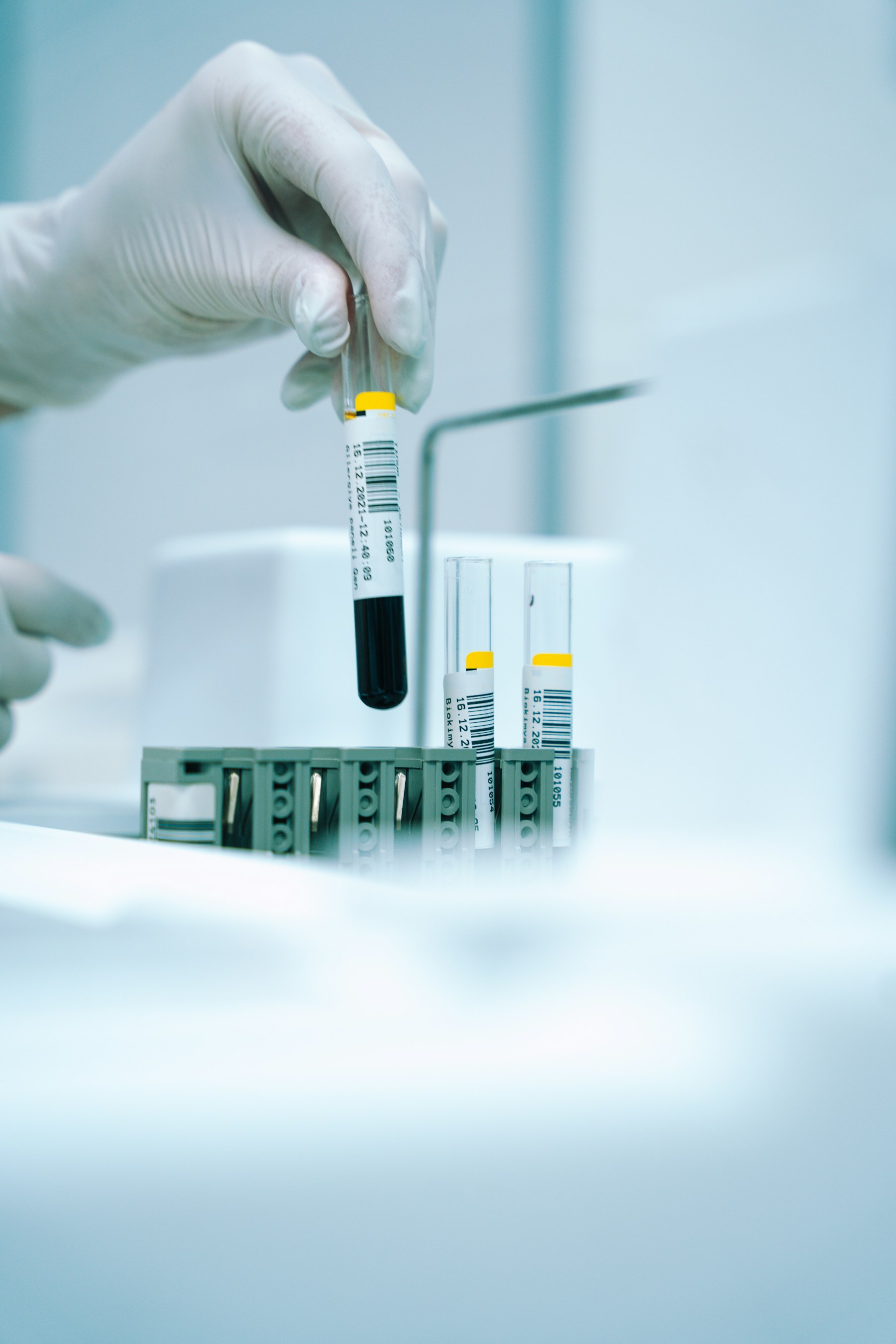
Samples that are ready to analyse
Aniva sells the testing and your laboratory runs the analysis
Aniva sells diagnostics as a service to companies that want blood testing under their own name, and the analysis itself is run by accredited partner laboratories.
Your laboratory is one of those partners, paid per analysis, with no sales effort of its own.

Small buyers order too little for anyone to serve them
Two problems are common to laboratories across Europe, and both are visible in Germany, where Aniva sells today: reimbursement has been cut, and the buyers who want testing are smaller and more numerous than before.
Reimbursement was cut while costs went up
The published devaluation was about 13.9 percent for general laboratory work and about 9.6 percent for specialist laboratory work, and the association describes members operating on small margins.
Each small buyer costs more to serve than it pays
A clinic, an app or a brand ordering a few hundred samples a year needs its own contract, its own requisition and its own result format, which is why most laboratories decline that work.
Logistics is a named cost line
The association's own statement names sample transport and information technology as two of the cost increases that laboratories are absorbing.
You receive their orders in the same format
The work a laboratory does not want is the selling, the requisitioning and the chasing, so those are the three things Aniva does before your intake.
What that looks like from the order to the release
Putting many buyers into one order format has four steps, and the first three of them are ours.
Aniva sells and contracts
Aniva holds the commercial relationship with the clinic, the app, the brand or the insurer, so your sales effort is one relationship rather than many.
Orders are put in the same format
Every order has the requisition already complete, whichever customer it came from.
Samples are routed by scope
Your accreditation scope, your region and your capacity decide what is sent to you, so you receive the analyses you actually run.
You analyse and release
Your laboratory runs the analysis under its own accreditation and releases the result, and Aniva delivers it to the customer.
What Europe spends on diagnostic testing
In vitro diagnostics means testing done on a sample outside the body, which is the work your analysers already do. These are the published figures for Europe, and the largest single market in it is Germany, where Aniva sells today.
in vitro diagnostics revenue across the EU-27, EFTA and the United Kingdom in 2023
was the German market in that year, which is the largest in Europe ahead of France, Italy and Spain
per person across the region, from 4.10 euro in Bulgaria to 63.70 euro in Switzerland
of current health spending across the region is in vitro diagnostics
Who is responsible for each part of it
Aggregated volume is only worth taking if the split is clear, so this is what Aniva runs and what stays with your laboratory.
Who does what
Serving those buyers directly

With Aniva
Your accreditation scope decides what we send your laboratory
An accreditation under ISO 15189 is granted for defined examination areas, which means a combination of analyte, sample material and technique, and it is granted for named sites. A supplier that says only that its laboratories are accredited has told a buyer nothing they can check.
Your laboratory receives the analyses it is accredited for, at the site that is accredited to run them, which is why nothing arrives that you do not already run.
The questions laboratory directors ask next
Directors at this point ask about ownership, methods and predictability, and these are the answers.
Aniva does, because the clinic, the app or the brand is our contracting partner, and your laboratory is paid per analysis rather than asked to sell.
No, because your existing accreditation scope decides the routing, and nothing is sent that your laboratory does not already run at that site.
In one format, with the requisition complete before the sample reaches you, so intake is not a sorting exercise.
Venous and capillary blood, including collection at home, as well as saliva, urine and stool, and the method is chosen by what the parameter needs.
That is the point of aggregating many small buyers, and we will show you the actual pattern for your region and your scope before anything is agreed.
A short call about your scope, your sites and your capacity, and no commitment is needed to have it.
Sources on this page. European market size, spending per person and the national ranking: MedTech Europe, European IVD Market Statistics Report 2025, figures for 2023. Reimbursement devaluation and cost lines in Germany: ALM e.V., ALM Aktuell Spezial Laborreform, March 2025, and association statements of 2024. German market structure: Vogeser M, Schumacher T, Bühling F, Medizinische Labordiagnostik in Deutschland, ein Statusbericht 2024, GMS German Medical Science, 2025. Accreditation scope: DAkkS, Regel zur Akkreditierung von medizinischen Laboratorien nach DIN EN ISO 15189:2024, document R-15189, revision 1.1, 11 October 2024.
What happens on the call
Bring your accreditation scope and your sites, and we will show you which of the analyses we already route would fit them.