Is Coke Zero Bad for You? The Answer May Surprise You.
Yes, water is healthier than Coke Zero. But that's not the question most people are really asking. The real question is: how bad is Coke Zero, actually? And how does it compare to the regular stuff? We went through the research so you don't have to in an editorial article.
Written by
Jan Haecker
Published on
May 23, 2026
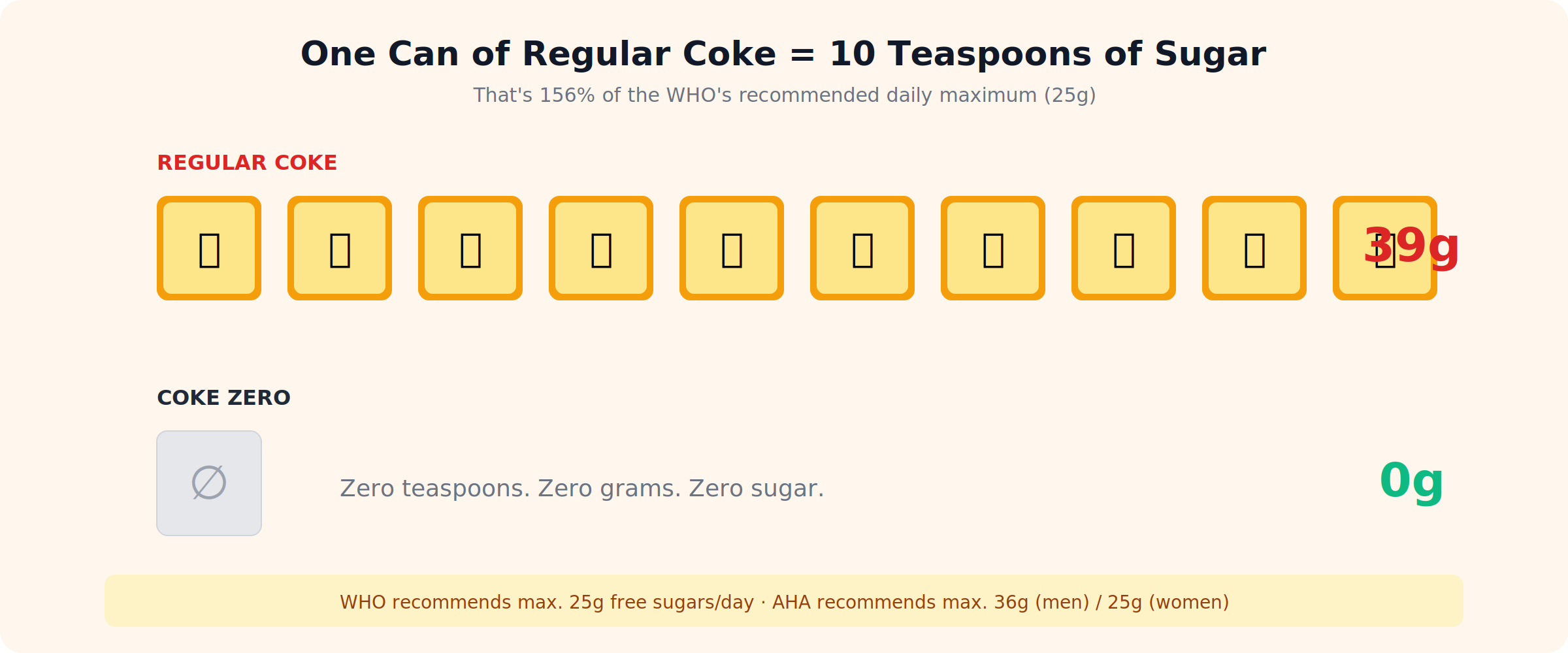
Let's start with the basics. A standard 355 ml (12 oz) can of regular Coca-Cola contains 140 calories and 39 grams of sugar,: that's roughly 10 teaspoons. A single can already exceeds the WHO's recommendation of no more than 25 grams of free sugars per day.
A can of Coke Zero contains zero calories and zero sugar. Instead, it's sweetened with about 85 mg of aspartame and 46 mg of acesulfame potassium (Ace-K). Both drinks have roughly 34 mg of caffeine, phosphoric acid, and caramel color. Neither contains any meaningful nutrients.
Regular Coca-Cola (355 ml)
Coke Zero (355 ml)
Calories
140 kcal
0 kcal
Sugar
39 g (~10 tsp)
0 g
Aspartame
0 mg
~85 mg
Acesulfame-K
0 mg
~46 mg
Caffeine
~34 mg
~34 mg
pH (acidity)
2.37
2.96
The trade-off is straightforward: regular Coke delivers a massive sugar load. Coke Zero swaps that for two artificial sweeteners.
The case against regular Coke is settled
The science on sugar-sweetened beverages is about as clear as nutrition science gets. A 2024 meta-analysis covering 1.5 million people found that high sugar-sweetened beverage intake is associated with an 18% increased risk of obesity. A 2023 meta-analysis of 72 studies found that each daily serving of sugary soda carries a relative risk of 1.20 for type 2 diabetes. The landmark Malik et al. meta-analysis (310,819 participants) found that 1 to 2 daily servings meant a 26% greater risk of developing diabetes.
An umbrella review published in Annual Reviews in 2024: synthesizing 47 meta-analyses and data from 22 million individuals, classified the link between sugary beverages and cardiovascular disease, type 2 diabetes, and depression as "convincing" evidence.
One daily can of regular Coke adds about 51,100 calories per year. That's the equivalent of roughly 6.5 kg (14.5 lbs) of potential weight gain if not offset by exercise or eating less elsewhere.
What does the science say about Coke Zero's sweeteners?
This is where it gets more nuanced. Here's what the research actually shows, broken down by the concerns people have.
Cancer risk: low, but not zero
In July 2023, the WHO released two assessments simultaneously. The International Agency for Research on Cancer (IARC) classified aspartame as Group 2B, "possibly carcinogenic to humans." At the same time, the Joint FAO/WHO Expert Committee (JECFA) reaffirmed the safety limit of 40 mg/kg/day, finding no convincing evidence of harm at typical intake levels.
Group 2B is the third-highest of four categories and includes things like aloe vera extract and pickled vegetables. It means "limited evidence," not confirmed danger. The FDA explicitly disagreed with the IARC classification, citing significant shortcomings in the underlying studies.
Gut health: real effects, but inconsistent
A landmark randomized controlled trial published in Cell in 2022 (Suez et al.) tested four sweeteners on 120 healthy adults. All four altered gut microbiome composition, but the effects were highly individual. Some people responded strongly, others not at all. Importantly, aspartame is broken down in the small intestine before it ever reaches the colon where most gut bacteria live. A 2020 RCT using realistic aspartame doses found no significant microbiota changes. The evidence is stronger for saccharin and sucralose than for aspartame specifically.
Insulin and metabolism: the emerging question
Short-term human studies generally show no significant effect of aspartame on blood sugar or insulin. However, a February 2025 mouse study published in Cell Metabolism found that aspartame at doses equivalent to roughly 3 cans per day activated the parasympathetic nervous system, increased insulin secretion, and worsened atherosclerotic plaque. This is an animal study and it cannot be directly applied to humans, but the mechanism is biologically plausible and worth watching.
Weight: the good news
This one actually goes in Coke Zero's favor. Despite persistent headlines linking diet soda to weight gain, the gold-standard evidence tells a different story. The SWITCH trial (2024, 493 participants) found that diet beverage drinkers maintained 7.5 kg of weight loss versus 6.1 kg for the water group over a year. A 2022 JAMA Network Open meta-analysis confirmed that switching from regular to diet soda reduces body weight, BMI, and body fat. Randomized controlled trials consistently show diet soda does not cause weight gain.
How much can you safely drink?
Health authorities set an Acceptable Daily Intake (ADI). This is the amount considered safe to consume every single day for your entire life, built with a roughly 100-fold safety margin.
Authority
Aspartame ADI
Acesulfame-K ADI
WHO / JECFA
40 mg/kg/day
15 mg/kg/day
EFSA
40 mg/kg/day
15 mg/kg/day
FDA
50 mg/kg/day
15 mg/kg/day
No authority changed its aspartame ADI after the 2023 WHO review. EFSA actually raised the Ace-K limit in April 2025, signaling increased confidence in safety.
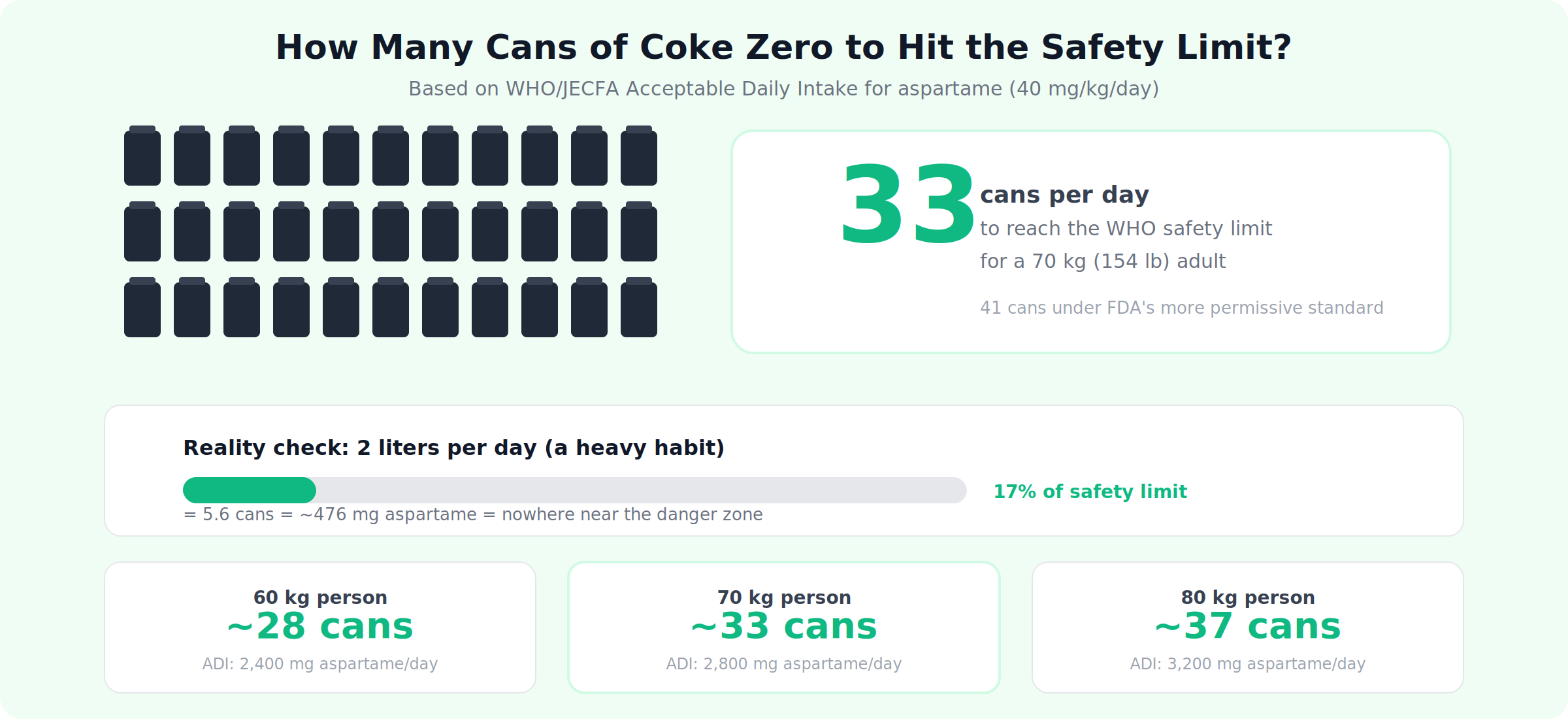
With ~85 mg of aspartame per can, a 70 kg adult would need to drink roughly 33 cans per day to hit the WHO limit, or 41 cans under the FDA's standard. A 60 kg person could have ~28 cans; an 80 kg person ~37 cans. These are safety ceilings, not recommendations. They show that moderate consumption is far below any threshold where agencies have identified risk.
Real-world example: what happens if you drink 2 liters a day?
Two liters of Coke Zero per day is roughly 5.6 cans. A lot of people actually drink this much, so let's break down what it actually means for your body.
Sweetener load: totally fine. That's about 476 mg of aspartame, roughly 17% of the daily safety limit for a 70 kg person. Not even close to a problem by any regulatory standard.
Caffeine: moderate. Around 190 mg total, equivalent to about two cups of coffee. Not an issue unless you're drinking coffee on top of it.
Your teeth: this is the real concern. Two liters of a liquid with a pH of 2.96 washing over your enamel throughout the day is genuinely erosive. If you're sipping across hours, which most people do, your teeth never get a chance to recover. Over months and years, this causes visible enamel thinning.
Here's what that looks like in practice. Your teeth have a hard outer layer called enamel, the hardest substance in your body. But it doesn't regenerate. Once it's gone, it's gone forever.
With chronic acid exposure, the enamel gradually dissolves. Your teeth start looking more yellow, not from staining, but because the thinner enamel lets the yellowish dentin layer underneath show through. Edges of your front teeth may look translucent or glassy. Then comes sensitivity: hot coffee, cold water, and sweet foods start causing sharp pain because the protective barrier is too thin to insulate the nerves.
Your dentist will spot this easilym thinned enamel has a distinctive smooth, widespread pattern that looks different from cavities. Left unchecked, it eventually leads to exposed dentin, rapid decay, cracking, and expensive crowns.
The critical point: sipping 2 liters over 8 hours is much worse than drinking it quickly. Your saliva needs about 30 minutes to neutralize the acid and begin remineralization. Constant sipping means your mouth never gets that recovery window.
Gut effects: uncertain. At that volume, you're getting consistent daily sweetener exposure. Some people may see microbiome shifts; others won't. The research shows highly individual responses.
You're displacing water. Two liters of Coke Zero likely means you're drinking less plain water than you should. Not catastrophic, but not ideal.
Bottom line on 2L/day: The sweetener dose is safe. Your teeth are the main casualty. If you can cut it down to 1 liter and fill the gap with sparkling water, that's a meaningful improvement, mostly for your dental health. Using a straw, rinsing with water after drinking, and waiting 30 minutes before brushing also help.
Both drinks damage your teeth, but regular Coke is worse
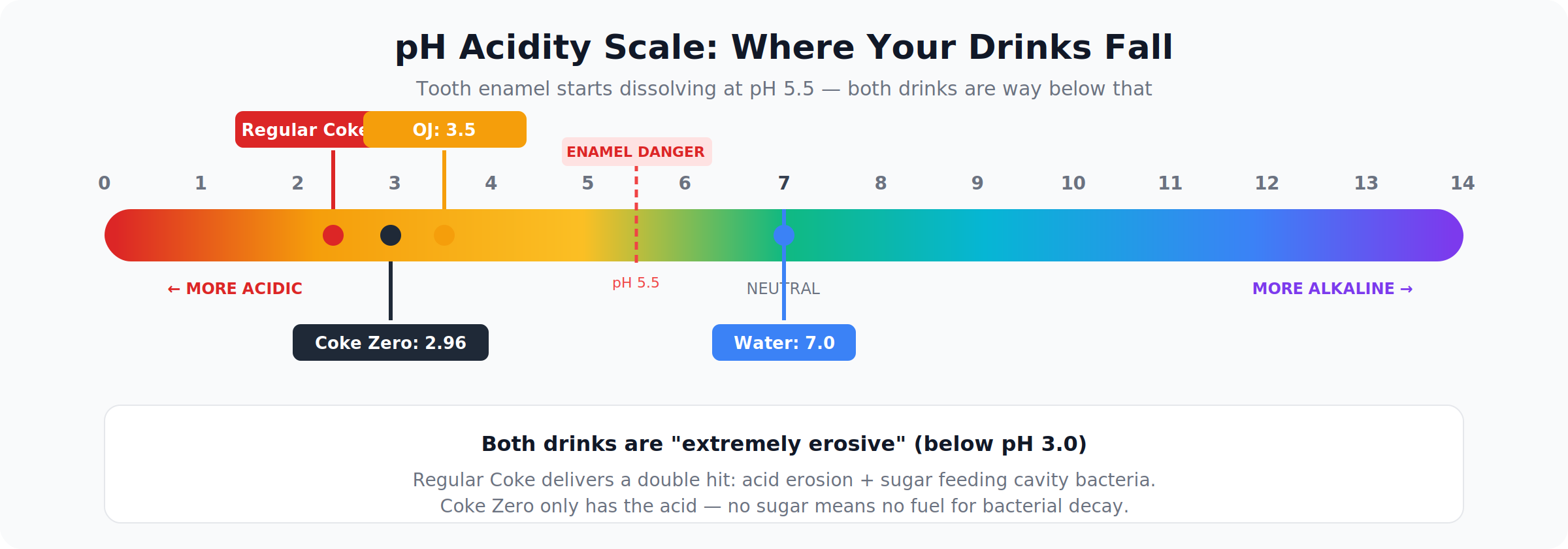
Both drinks are highly acidic: regular Coke at pH 2.37 and Coke Zero at pH 2.96, both well below the pH 5.5 threshold where enamel starts dissolving. But regular Coke delivers a double hit: the acid erodes enamel directly, while the 39 grams of sugar feed cavity-causing bacteria that produce even more acid. Coke Zero eliminates the bacterial pathway entirely, no sugar, no fuel for cavities. But the direct erosive attack from phosphoric acid remains.
For dental health specifically, Coke Zero is meaningfully better than regular Coke but still damaging with frequent exposure.
Where Coke Zero sits on the beverage spectrum
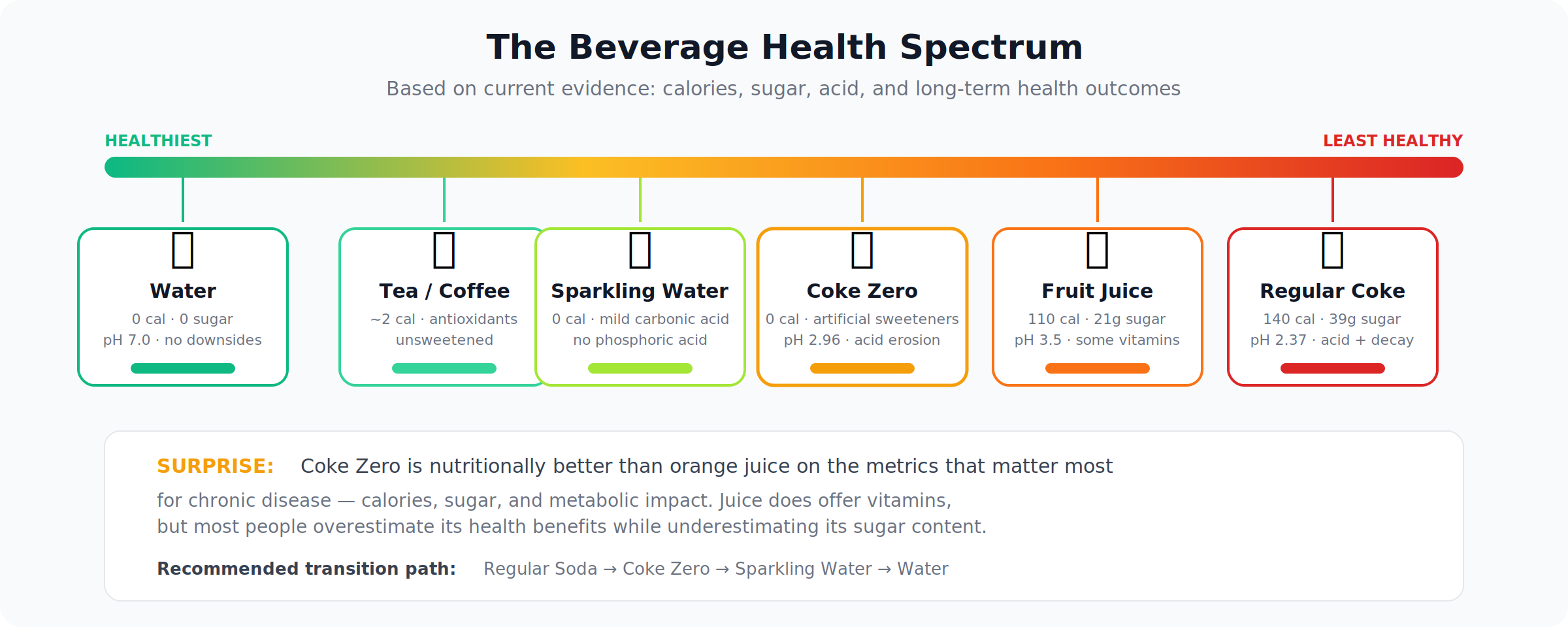
The practical hierarchy, based on current evidence:
Water and unsweetened tea/coffee → the gold standard. Zero calories, zero acid, zero downsides.
Sparkling water → provides the carbonation without phosphoric acid.
Coke Zero → sits here. No sugar, no calories, but acid and artificial sweeteners.
Fruit juice → a 355 ml glass of orange juice has ~110 calories and 21 grams of sugar with a pH of about 3.5. Nutritionally, Coke Zero is actually better on the metrics that matter most for chronic disease.
Regular soda, energy drinks, sweetened juices → at the bottom. Substantial sugar loads with well-documented health harms.
What doctors actually recommend
The professional consensus lands on a practical middle ground.
The American Heart Association calls diet beverages a "useful replacement strategy" for adults switching from sugary drinks, while recommending water as the primary beverage. The American Diabetes Association lists diet soda as an acceptable alternative for people with diabetes, while prioritizing water.
The WHO's May 2023 guideline suggested that non-sugar sweeteners should not be used as a weight-control strategy, but this was a conditional recommendation based on low-certainty evidence. It was not a ban, and it explicitly excluded people with pre-existing diabetes.
Most registered dietitians converge on 1 to 2 cans per day as a reasonable moderate intake. The practical recommendation from most practitioners follows a stepwise approach: regular soda → diet soda → sparkling water → water.
The bottom line
Three things are clear from the evidence.
Switching from regular Coke to Coke Zero is an unambiguous health improvement. You're eliminating 39 grams of sugar and 140 calories per can. Randomized trials confirm this leads to weight loss without metabolic worsening.
Coke Zero at moderate intake (1 to 2 cans daily) poses minimal demonstrated risk to most adults. Actual consumption falls far below every major safety threshold.
Coke Zero is not a health drink. Emerging research on gut health, the 2025 animal findings on insulin-mediated atherosclerosis, and consistent dental erosion make it clear that it's not equivalent to water.
The most honest way to think about it: Coke Zero is a reasonable harm-reduction tool, not a health choice. If you're drinking regular Coke, switching to Zero is a smart move. But the goal should be progressing toward water, not permanent reliance on artificially sweetened alternatives.
With Aniva, you can see what is really going on. You can avoid persistent, painful and costly blind spots in the most important part of your life: your wellbeing.
Thank you! Your submission has been received!
Oops! Something went wrong while submitting the form.
Your future self is waiting
Start building the healthiest decade of your life.